

.png&w=1920&q=75)
The IGIC for vacation rentals in the Canary Islands in 2026 is one of the most important tax aspects that any property owner renting to tourists should understand.
It is not just about knowing whether it must be paid, but about understanding when IGIC applies, how a vacation rental is taxed, which forms need to be filed, and how to calculate the tax correctly.
In this complete guide, you will find everything you need to comply with your tax obligations for vacation rentals in the Canary Islands, optimize your profitability, and avoid mistakes in your tax filings.
What is IGIC and why it applies to vacation rentals
The IGIC (Canary Islands General Indirect Tax) is the indirect tax specific to the Canary Islands, equivalent to VAT in mainland Spain.
In 2026, the general rate remains:
7% applied to tourist accommodation services
When you rent a property as a vacation rental, the authorities consider that you are carrying out:
An economic activity providing accommodation services
This means:
It is not a traditional rental
It is not treated as a primary residence
It is subject to specific tourism and tax regulations
That is why IGIC is mandatory in most vacation rental cases in the Canary Islands.
When do you pay IGIC in vacation rentals
The key factor is not the length of the stay, but its touristic purpose.
Cases where IGIC applies
Situation | IGIC applies |
|---|---|
Listed on Airbnb or Booking | Yes |
Short-term stays with frequent turnover | Yes |
Tourist use of the property | Yes |
Continuous commercial activity | Yes |
In these cases, the 7% IGIC is applied to the accommodation service.
Cases where IGIC does NOT apply
Situation | IGIC applies |
|---|---|
Long-term residential rental | No |
Permanent residence contract | No |
Rental for work or study purposes | No |
No tourist marketing | No |
In these situations, it is considered a civil rental, not a tourist activity.
General regime vs REPEP in vacation rentals: which one to choose
When a vacation rental is subject to IGIC in the Canary Islands, the owner must understand a key difference: not all taxpayers are treated the same. In practice, the two main options are the general IGIC regime and the REPEP (Small Business Special Regime).
The choice between the general regime and REPEP directly affects:
How you issue invoices
Whether you charge IGIC to guests
Whether you can deduct expenses
Which tax forms you must file
What is the general IGIC regime
The general IGIC regime is the standard taxation system. Under this regime, the vacation rental owner is considered a business operator for tax purposes.
This means they must:
Obligation | General IGIC regime |
|---|---|
Charge IGIC to guests | Yes |
Apply the appropriate tax rate | Yes |
Submit periodic tax returns | Yes |
Deduct IGIC on expenses | Yes, if requirements are met |
Keep records of income and expenses | Yes |
Under this regime, the owner collects IGIC within the accommodation price and then declares it to the Canary Islands Tax Agency using Form 420. In addition, they can deduct IGIC paid on expenses related to the activity, such as cleaning, maintenance, utilities, renovations, furniture, platform commissions, or professional services, as long as they are properly documented.
The general regime is usually more suitable when the property generates significant income, there are deductible expenses, or renovations and investments are planned.
What is REPEP
REPEP stands for the Small Business Special Regime (Régimen Especial del Pequeño Empresario o Profesional). The Canary Islands Tax Agency defines it as a special IGIC regime that provides a tax exemption threshold for self-employed individuals established in the Canary Islands, provided they do not exceed the turnover limits established by law.
In 2026, the Canary Islands Tax Agency (ATC) indicates on its Form 400 page that certain individuals with an annual turnover not exceeding €50,000 may fall under this regime. This includes those engaged exclusively in property rental activity and individuals who qualify for REPEP.
In practice, being under REPEP means:
Obligation | REPEP |
|---|---|
Charge IGIC to guests | No |
Pay IGIC on bookings | No, generally |
File quarterly Form 420 | Usually not required |
Deduct IGIC on expenses | No |
Issue invoices with IGIC | No; must include exemption note |
Keep income records | Yes |
The ATC states that transactions carried out in the Canary Islands by taxpayers under REPEP are generally exempt from IGIC. It also specifies that invoices must be issued without IGIC and include the wording:
“Exempt under the small business tax regime (REPEP)”
REPEP does not mean the activity does not exist or that there are no tax obligations. It means that, if requirements are met, IGIC is not charged to the guest due to the exemption threshold.
Key differences between the general regime and REPEP
Key aspect | General regime | REPEP |
|---|---|---|
Typical profile | Medium/high-income owners or multiple properties | Small individual owners |
IGIC charged to guests | Yes | No |
Form 420 | Yes | Usually not |
Form 425 | Yes, when applicable | May be required as an informative return |
Deduction of IGIC on expenses | Yes | No |
Administrative complexity | Higher | Lower |
Tax efficiency | Better with high expenses/investment | Better for simplicity |
Flexibility | Greater tax control | More limited |
How to choose the right regime
The decision should not be based only on “paying less tax,” but on how the vacation rental activity is structured.
REPEP may be suitable if:
You are an individual resident or established in the Canary Islands
You have one property or a small activity
Your turnover is below the legal threshold
You have limited deductible expenses
You prefer simple tax management
You want to avoid quarterly IGIC filings (if not required otherwise)
The general regime may be suitable if:
You own multiple vacation rental properties
You exceed or expect to exceed REPEP limits
You plan renovations or investments
You have significant business expenses
You want to deduct IGIC on costs
You operate the rental as a growing business
Practical rule
If you have low income and few expenses, REPEP can simplify management.
If you have higher income, multiple properties, or significant costs, the general regime usually offers better tax optimization.
Practical example: which regime may suit you
Case | Situation | Recommended regime |
|---|---|---|
Owner A | One property, moderate income, few expenses | REPEP |
Owner B | Recently renovated property, high deductible costs | General regime |
Owner C | Two or more high-occupancy properties | General regime |
Owner D | Small-scale activity, simple management | REPEP |
Step-by-step: how to declare vacation rental taxes in the Canary Islands
This is the full process any property owner must follow:
Step 1: Register with Form 400
Form 400 is the mandatory first step to register as a business or professional in the Canary Islands and declare the start of your vacation rental activity, as well as choose your tax regime (general or REPEP).
It must be submitted before starting to rent the property.
Form 400 is also used to report changes or to cease activity.
Step 2: Issue invoices
If you operate a vacation rental, you are carrying out an economic activity, so you must issue an invoice for each stay.
An invoice must include:
Invoice number
Issue date
Owner details (name, tax ID, address)
Client details (name; tax ID if applicable)
Description of the service, property address and stay dates
Total booking price (paid by the guest)
Taxable base (amount excluding IGIC)
IGIC rate (typically 7%)
IGIC amount
If you are under REPEP, IGIC is not included. The invoice must state:
“Exempt under the Small Business Special Regime (REPEP)”
Step 3: Record income and expenses
In the Canary Islands, you can deduct IGIC on expenses directly related to your activity.
To be deductible, a cost must:
Be related to the vacation rental activity
Have a valid full invoice (not a simple receipt)
Include IGIC breakdown
Be issued in the owner’s name
Be properly recorded in your accounts
Examples of deductible expenses:
Platform commissions, cleaning, utilities, maintenance, furniture, renovations, professional services
Step 4: File Form 420
Form 420 is the quarterly IGIC tax return, where you declare:
IGIC charged to guests (output tax)
IGIC paid on expenses (input tax)
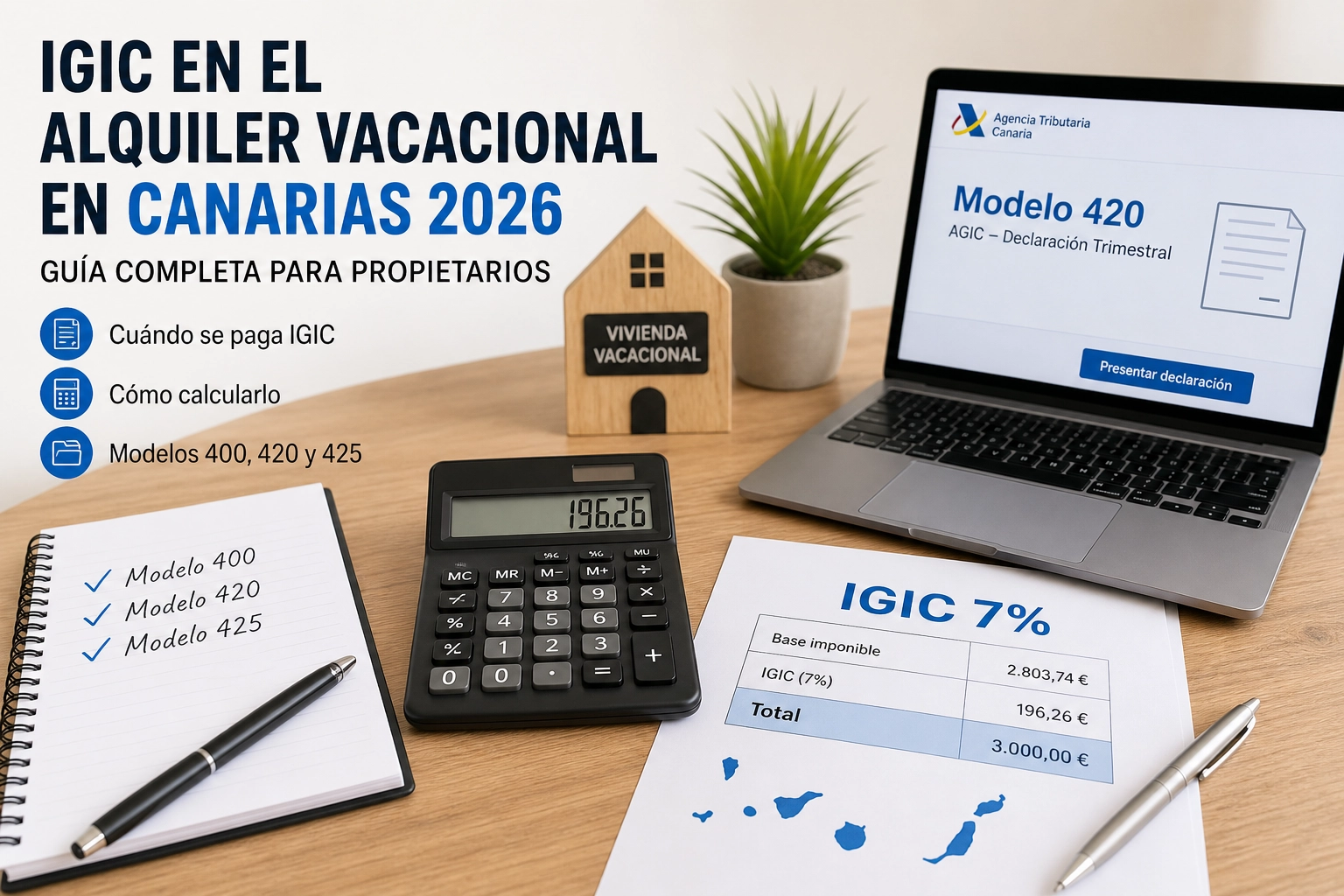
Example calculation
Income:
Total bookings: €3,000
IGIC included: €196.26
Expenses:
Cleaning + utilities
IGIC paid: €80
Result:
IGIC charged: €196.26
IGIC paid: €80
👉 Tax to pay:
196.26 – 80 = €116.26
Step 5: File Form 425
Form 425 is the annual IGIC summary return. Unlike Form 420, it does not involve paying tax, but reporting the total yearly activity.
Submission date: January of the following year
It allows the Tax Agency to:
Verify your activity
Check consistency with quarterly filings
Detect errors or discrepancies
Final note
The IGIC for vacation rentals in the Canary Islands is not just a tax formality — it is part of the daily management of any tourist property.
If not handled properly, it can directly impact your profitability and lead to administrative issues.
Need help managing your vacation rental?
At Pambnb, we specialize in managing vacation rentals in the Canary Islands.
We handle daily operations and offer additional support for administrative and tax-related processes.
Contact us and find out how we can help you manage your property efficiently.