

What Owners Should Decide Now. Tenerife Winter Rental Pricing 2026/27.
Published by Pambnb · Seasonal revenue strategy for Tenerife property owners
This article is for informational purposes only and does not constitute legal or tax advice.
If you are planning to look at your winter rates in November, the most valuable bookings of the season will already be sitting in someone else's calendar. Winter in Tenerife is decided in late summer. Guests who spend three or four weeks on the island in January book early, compare a handful of properties over several weeks, and commit long before the weather turns cold in northern Europe. Tenerife Winter Rental Pricing 2026/27
That makes August and September the real pricing season for a Tenerife vacation rental, not December.
At a glance
Decision | When to make it | Why it matters |
Winter nightly rates | August and September | The winter sun booking window opens early and closes gradually |
Christmas and New Year minimum stay | August | Short gaps between two long bookings are almost impossible to fill in December |
Long-stay discount structure | September | Monthly guests compare a small shortlist and book weeks in advance |
Property adjustments for long stays | September and October | Workspace, laundry and storage decide who books a 28-night stay |
Cancellation and payment terms | Before the first winter booking | Long stays carry more exposure than a four-night booking |
Winter is not low season in Tenerife
Most seasonal pricing advice written for Spain assumes the mainland pattern: a busy summer, a dead winter, and a scramble for occupancy between them. Tenerife does not work that way, and owners who copy mainland logic leave money in the calendar.
The island's winter demand is driven by people escaping the cold rather than chasing the beach. Daytime temperatures in the south generally sit in a comfortable range through December, January and February, which turns those months into the strongest part of the year for a large part of the market. Market data on Tenerife availability suggests February is the tightest month of the winter, with January close behind and December not far off, meaning that a property priced as if winter were a quiet period is usually underpriced.
Occupancy data supports the same picture. In mid-2026, AirDNA reported around 65% annual occupancy across roughly 5,300 active listings in Adeje, and a similar occupancy level in Puerto de la Cruz across a much smaller supply of about 1,500 listings. Those are annual averages, not winter peaks, in a market where a genuinely weak season would drag the number well below that.
The practical conclusion is simple. In most of the south, winter should be priced as a second high season with its own rules, not as a discount period.
💬 Not sure whether your property is priced as low season by mistake? Ask Pambnb for a winter rate review
Month by month: what winter demand actually looks like. Owner’s Guide.
Winter is not one block. It behaves like four different markets, and a single flat rate across all of them is the most common pricing mistake we see.
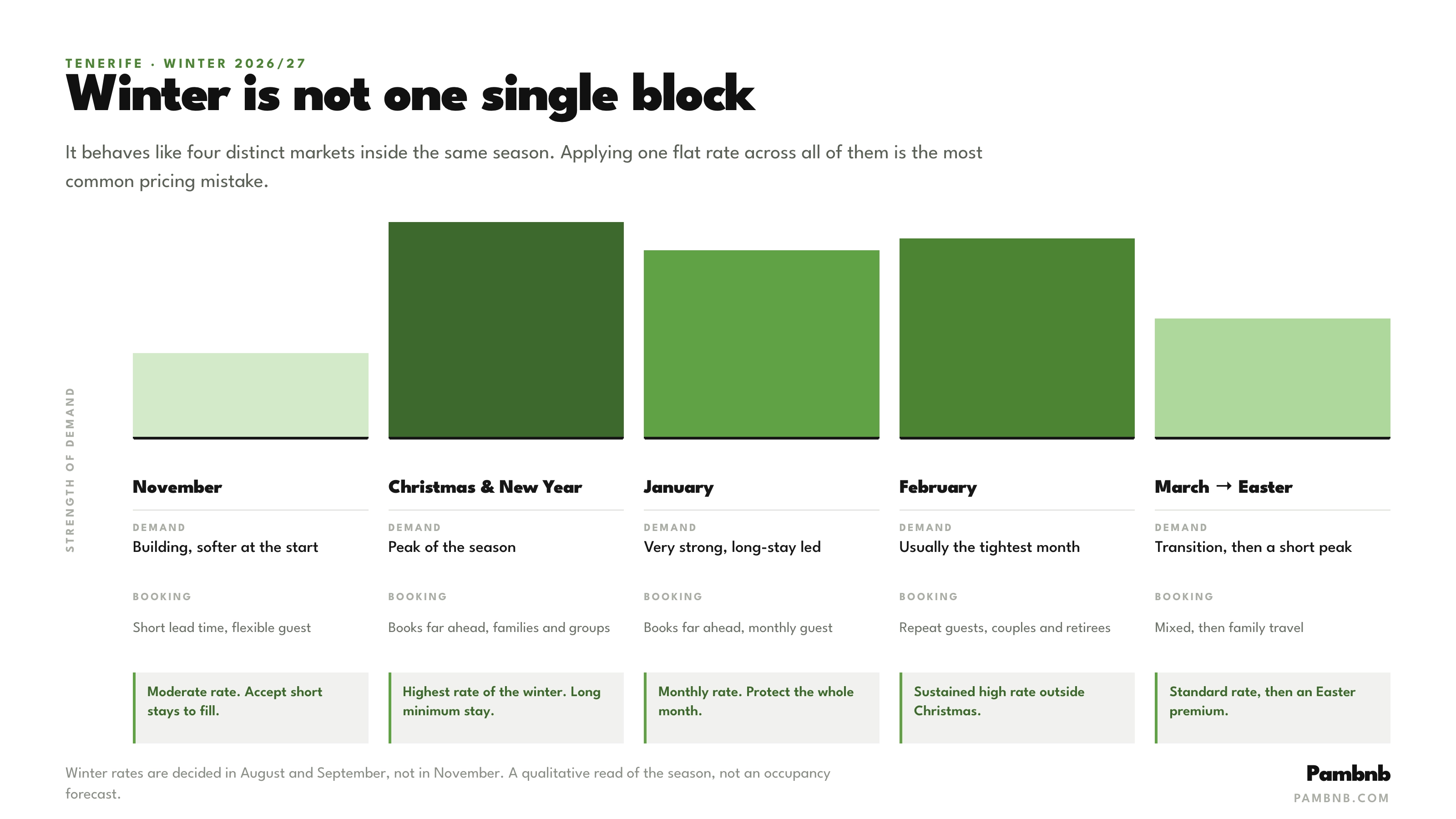
Period | Demand profile | Typical booking behaviour | Pricing approach |
November | Building, softer at the start | Shorter lead times, more flexible guests | Moderate rates, accept shorter stays to fill gaps |
Christmas and New Year | Peak of the season | Booked far in advance, families and groups | Highest rates of the winter, longer minimum stay |
January | Very strong, dominated by long stays | Long lead times, monthly guests | Monthly pricing, protect the whole month |
February | Usually the tightest month | Repeat winter guests, couples and retirees | Highest sustained rates outside Christmas |
March into Easter | Transition, then a short spike | Mixed, then family travel | Standard rates, then an Easter premium |
Two of these deserve their own treatment.
The Christmas and New Year block
The two weeks around Christmas and New Year are the only period of the Tenerife winter where a badly placed booking can cost you more than an empty night. A four-night reservation dropped in the middle of that fortnight can make the surrounding nights unsellable, because almost nobody travels to Tenerife for three nights at Christmas.
A minimum stay is the tool that protects it. Set it before the period starts filling, not after you have accepted the first short booking, and set it long enough that the block sells as a unit rather than as fragments.
Carlos owns a one-bedroom apartment in Golf del Sur. Last winter he accepted a four-night booking starting on 27 December because it looked like good money at the time. It left him with a three-night gap before it and a five-night gap after it, neither of which sold. He earned four nights of revenue in the strongest fortnight of his year.
January and the long-stay guest
January is the month where the long-stay market takes over. The guest is not a tourist in the usual sense. They are working remotely, retired, recovering, or simply relocating their winter for a month or two. They book earlier than everyone else, they compare fewer properties, and they read the listing far more carefully.
They can also be among the most profitable guests a Tenerife owner hosts all year, for reasons that have little to do with the headline nightly rate.
The long-stay maths owners get wrong
The instinctive objection to a monthly booking is that the discount destroys the margin. That comparison is almost always made against a fantasy: a month of back-to-back short bookings with no gaps, no cleaning between them and no unsold nights.
Here is a more honest comparison. The figures below are illustrative and use round numbers to show the mechanism, not a promise of what any specific property will earn.
/im
30 nights of short bookings | One 28-night stay | |
Realistic occupancy in the month | 20 to 23 nights sold | 28 nights sold |
Nightly rate | Full rate | Discounted, often 20% to 30% lower |
Cleaning and turnover events | 5 to 7 | 1 |
Guest communication load | 5 to 7 arrivals | 1 arrival |
Linen, consumables, wear | High | Low |
Risk of unsold gaps | High | None once booked |
Platform commission exposure | On every booking | On one booking, or zero if booked direct |
A 25% discount on the nightly rate looks painful until you notice that it is applied to 28 sold nights instead of 21, with one turnover instead of six. In the illustrative scenario above, the long stay produces more net revenue and requires far less work.
There is a second effect that rarely gets counted. Long-stay guests are the easiest guests to convert to direct booking for the following year, because a month is long enough to build a relationship. A returning January guest booked through booking.pambnb.com avoids OTA platform commission, although payment-processing or management fees may still apply. Airbnb and Booking.com charges vary by account, property and agreement, so compare the actual fee shown in each channel.
Maria rents a two-bedroom apartment in the north. She used to sell January in five- and six-night blocks and finished most Januaries around 70% occupancy. Two winters ago she added a monthly rate, adjusted the desk and the storage, and now sells January and February to the same returning couple. Her nightly rate is lower. Her January revenue is higher, and she cleans the apartment twice instead of eleven times.
💬 Want the long-stay numbers run on your actual property? Talk to Pambnb about winter revenue
What a long-stay guest actually needs
A guest staying four nights forgives almost everything. A guest staying four weeks does not. The properties that win the winter long-stay market in Tenerife are rarely the most luxurious ones. They are the ones that work as a temporary home.
The things that decide a monthly booking, roughly in order of importance:
A real internet connection, stated in numbers. "Fast Wi-Fi" means nothing to someone who works online. A fibre connection with the speed written in the listing is a selling point, and it is why properties like our Golf del Sur apartment with 500 Mb fibre perform well with this segment.
A workspace that is a desk and a proper chair, not a dining table photographed at a flattering angle.
A washing machine in the apartment. This is close to non-negotiable above two weeks.
A kitchen that supports actual cooking, including an oven, enough hob space and storage for a real weekly shop. Long-stay guests eat out far less than holiday guests.
Storage. Empty wardrobe space and somewhere to put a suitcase out of sight. Living out of a bag for a month is miserable.
Comfort in the evening. Winter nights in Tenerife are mild but not warm, and northern European guests notice the difference between a well-equipped apartment and a summer one.
Clear, honest information about what the area is like out of season, including whether the local restaurants and services stay open.
None of this is expensive. Most of it is a weekend of work in September and a rewritten listing.
Where the legal line sits between a holiday let and a seasonal rental
This is the part of winter pricing where owners most often improvise, and it is worth being careful.
A vivienda vacacional operates under the Canary Islands tourist framework, including Law 6/2025 of 10 December on the sustainable regulation of the tourist use of homes, published in the BOC on 12 December 2025, together with other applicable rules. A seasonal rental, an alquiler de temporada, is a different legal instrument: article 3 of the Ley de Arrendamientos Urbanos treats rentals agreed for a season as rentals for a use other than permanent housing. In practice, the temporary purpose of the stay should be genuine, documented and reflected in the contract.
The two are not interchangeable, and the distinction is not determined by the number of nights alone. The purpose and actual use of the stay, the terms of the agreement and the rules applicable to the property all matter, with potentially different obligations for registration, taxation and reporting.
Do not assume that calling a booking a monthly holiday stay determines its legal status. Before accepting a multi-month booking or using a seasonal-rental contract, check that the arrangement matches the property's permitted use and obtain professional advice. Local planning rules and the facts of the stay may add further conditions.
If you are a non-resident owner, note that Order HAC/623/2026 changes Form 210 reporting. It adds a deductible-expense breakdown and, for rental income with tax payable, introduces an annual April filing timetable for income arising in 2026. The revised form applies to returns filed from 1 January 2027. Good bookkeeping will make the change easier to manage.
This article is for informational purposes only and does not constitute legal or tax advice. Rules vary by municipality and by individual circumstances. Consult a qualified professional before making decisions about your property.
💬 Unsure which framework your winter bookings fall under? Get a straight answer from Pambnb
Your winter pricing checklist for August and September - tenerife winter rental pricing
Work through these in order. Most of them take minutes.
Set your Christmas and New Year rates and minimum stay first, because that block fills earliest and is the least forgiving.
Build a January and February rate that assumes strong demand rather than hoping for it, then create a separate monthly rate underneath it for stays above 28 nights.
Decide your long-stay discount as a structure, not as a negotiation. A weekly discount and a monthly discount published in advance sell better than a rate you argue about by message.
Check your gap rules. A one-night or two-night gap between winter bookings is lost revenue, and most channels let you close them automatically.
Rewrite the listing for a winter audience. The photographs and the copy that sell a July beach holiday do not sell a January working month.
Confirm your terms, deposits and payment schedule for long bookings before the first one arrives, since the exposure on a 28-night stay is not the same as on a four-night one. Pambnb's booking conditions are always shown to the guest at the moment of booking.
Fix the workspace, the storage and the internet before the photographs, not after.
What Pambnb handles for owners - tenerife winter rental pricing
Task | Self-managed owner | With Pambnb |
Winter and seasonal rate setting | You, manually, per channel | Managed across all channels |
Christmas minimum stay strategy | You | Set and monitored |
Long-stay pricing and screening | You | Structured and applied |
Listing rewrite for winter demand | You | Included |
Guest communication across a month-long stay | You | Handled |
Cleaning, laundry, maintenance | You coordinate | Coordinated for you |
Direct bookings with no platform commission | Not available to most owners | Through booking.pambnb.com |
Reporting-ready income and expense records | You assemble | Prepared for you |
For owners who live off the island, the winter season is also the hardest one to manage remotely, because it is the longest continuous run of occupancy in the Tenerife calendar. That is exactly where a management partner earns its fee rather than costing it.
Frequently asked questions
When should I set my Tenerife winter rates? - Tenerife winter rental pricing
Generally in August and September. The winter sun market books early, and the guests who stay longest book earliest. By November you are competing for what is left rather than shaping the season.
Is winter really high season in Tenerife?
In most of the south, yes in practice. December, January and February are among the tightest months of the year for availability, and pricing them as a quiet period usually leaves revenue unclaimed. The north tends to be softer in winter, so the rate structure should differ by area.
How big should a monthly discount be?
A discount of 20% to 30% below the equivalent nightly rate can be a useful starting point, but it is not a rule. The right figure depends on your area, your property, your costs and the realistic alternative occupancy.
Are long stays worth it if the nightly rate drops?
Often, but not automatically. Compare the discounted stay with your realistic short-stay occupancy, including cleaning, utilities, commission, communication and the risk of unsold gaps.
Can I rent my vacation rental for three months in winter?
It depends. Longer bookings may fall under a different legal framework than the tourist one your licence covers, and the rules vary by municipality and by how the agreement is drafted. Take professional advice before committing to a stay of several months.
Do I need to change anything in the apartment for long stays?
Usually a desk and a good chair, a washing machine, an oven, empty storage space, and a stated internet speed. These decide monthly bookings far more often than luxury finishes do.
What about the tourist tax and access fees my guests ask about?
Guests increasingly ask about local costs. Since 19 January 2026, public fees have applied in certain time slots on the regulated PNT 10 Telesforo Bravo and PNT 07 Montaña Blanca to La Rambleta trails. Direct guests to Tenerife ON for current permits, fees and access conditions.
Ready to make this winter work harder?
👉 Check availability and book directly with Pambnb
👉 Talk to us about managing your Tenerife property
© 2026 Pambnb · Tenerife, Canary Islands · pambnb.com · booking.pambnb.com · Contact us