

Published by Pambnb · Winter revenue and compliance for Tenerife owners
Last updated: September 2026. This article is for informational purposes only and does not constitute legal or tax advice. Always consult a qualified lawyer or tax advisor for your specific situation. Tenerife Long-Stay Pricing After the New 31-Day Rental Law (2026)
Every October, owners in Tenerife make the same quiet decision without really examining it: they leave the calendar exactly as it was in August. Same minimum stay, same pricing rules, same expectation of a steady flow of one-week bookings.
Two things changed since our winter pricing guide went out in August. First, a piece of unfinished business from that article: the honest way to decide whether a long booking is worth taking isn't a rule of thumb, it's a number you calculate from your own property. Second, and more urgent: on 15 August 2026, one day after that guide was published, a new law changed exactly what a contract for 31 days or less has to say.
This article covers both, and keeps them separate, because mixing a pricing decision with a legal one is how owners end up thinking a discount has solved a compliance problem.
📅 What changed, at a glance
Date | What happened |
14 August 2026 | Pambnb's winter pricing guide published, covering the long-stay discount case |
31 July 2026 | Ley 7/2026 signed |
14 August 2026 | Published in the Boletín Oficial de Canarias, no. 163 |
15 August 2026 | Ley 7/2026 enters into force, adding Articles 11 and 12 to Ley 6/2025 |
25 October 2026 | Air Canada's first Toronto–Tenerife flight of the winter season |
31 October 2026 | Air Canada's first Montreal–Tenerife flight of the winter season |
Part one: the break-even number, not the rule of thumb
Our winter pricing guide already walks through why a full month sold to one guest usually beats the same month sold in short bookings: fewer turnovers, fewer gaps, one guest relationship instead of five or six. If you haven't read that comparison yet, start there — this section assumes you have, and goes one step further.
The guide suggests a monthly discount of 20% to 30% as a starting point. That's a reasonable range, but it's still a guess dressed up as a rule. The number that actually matters is different for every property, and it takes one division to find.
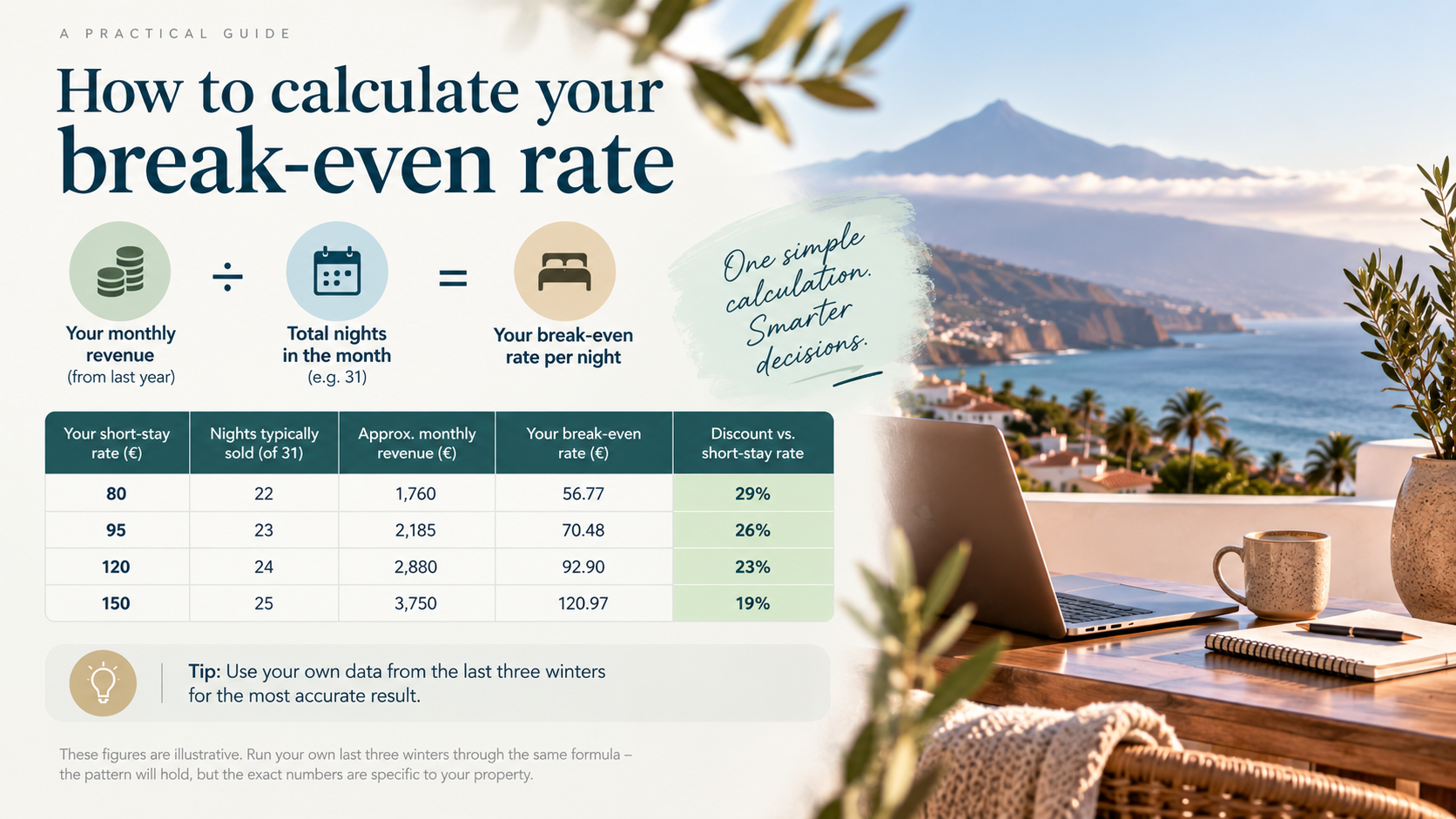
Take the revenue you realistically earned in a given month last winter, and divide it by the full number of nights in the month.
Say you sold 23 of 31 nights at €95 a night last January, in three or four separate bookings. That's roughly €2,185 for the month. Divide by 31, and your break-even rate for a full-month booking is €70.48 a night. At that rate, one long booking earns exactly what last January earned you, while you do one turnover instead of three or four. Anything above €70.48, and you're ahead on both revenue and workload.
Expressed as a discount off the €95 short-stay rate, that's about 26%, which happens to sit inside the guide's 20-30% range — but you now know why, instead of hoping the range applies to you.
Your short-stay rate | Nights typically sold (of 31) | Approx. monthly revenue | Your break-even rate | Discount vs. short-stay rate |
€80 | 22 | €1,760 | €56.77 | 29% |
€95 | 23 | €2,185 | €70.48 | 26% |
€120 | 24 | €2,880 | €92.90 | 23% |
€150 | 25 | €3,750 | €120.97 | 19% |
The figures above are illustrative, built from the formula, not market data. Run your own last three winters through the same division before you set a monthly rate — the pattern in the table (higher short-stay rates and better historical occupancy push the required discount down) will hold, but the exact numbers won't.
Two honest caveats. A long booking at a heavy discount on a property that already fills reliably is a loss, not a strategy, which is exactly why the break-even comes first. And a long booking concentrates your risk in one guest, which is why the screening advice in Part three matters more here than it does for a weekend stay.
💬 Want your own break-even run on your actual booking history? Talk to Pambnb about winter revenue
Why the window is opening wider this year: Air Canada has confirmed nonstop A321XLR service to Tenerife for the first time, two weekly flights from Toronto (Thursdays and Sundays, flight AC954) starting 25 October 2026, and one weekly flight from Montreal (Saturdays, flight AC956) starting 31 October 2026, running through the season to late April 2027. That's a new pool of long-haul travellers who can now reach the island directly. Whether it shows up as demand for your specific property is something your own booking data will tell you before any forecast will.
Part two: what Ley 7/2026 actually changed on 15 August 2026
This is a separate question from everything above, and it deserves to be treated separately.
Ley 7/2026, de 31 de julio, was published in the Boletín Oficial de Canarias no. 163 on 14 August 2026 and entered into force the following day. Among its provisions, it inserts two new articles, 11 and 12, into Ley 6/2025 on the sustainable regulation of the tourist use of homes — the same law behind the licence moratorium covered in our vacation rental law overview.
What Articles 11 and 12 say
Article | What it establishes | What it means for you |
Article 11 | A presumption of tourist activity in two independent situations: the property is advertised on a tourist offer channel, or it is let for a continuous period of 31 days or less, one or more times in the same year | 31 days is inside the threshold, not outside it. A calendar month of 30 or 31 days triggers the presumption on length alone |
Article 11 (advertising limb) | The presumption also arises from advertising on a tourist channel, regardless of stay length | Listing a three-month booking through Airbnb doesn't escape the presumption. Length of stay isn't a way around it |
Article 12 | The presumption is rebutted only if the reason for the letting is stated in the contract itself | This is a requirement, not one form of evidence among others. A contract that doesn't record the cause stays defective even when the reason is genuine |
Article 12.2 | The landlord must request the tenant's reason in writing, dated, before signing, then record it in the contract and be able to substantiate it if asked | The request has to happen in advance, not be reconstructed afterwards if there's ever a check |
Read together, two things follow. A stay of exactly 31 days doesn't sit outside the rule, it sits right at the edge of it. And advertising on a tourist platform creates the presumption on its own, independent of how long the guest stays.
What it costs to get this wrong
The sanctions sit under the Canary Islands tourism penalty regime (Ley 7/1995, de Ordenación del Turismo de Canarias, as amended by Ley 7/2026, Articles 76.24, 77.12 and 79.2).
Failure | Classification | Fine range |
Signing a contract for 31 days or less without stating the motivation and its connection to the planned duration | Serious (grave) | €1,501 – €30,000 |
Not requesting that information from the tenant in writing and in advance | Minor (leve) | Up to €1,500 |
Both are autonomous infractions. They sanction a documentary defect, not fraud — which is precisely why they're easy to fall into by accident and just as easy to avoid on purpose.
If you hold a VV licence
For most owners reading this, the answer is reassuring, but not for the reason people assume.
If you hold a vivienda vacacional licence and advertise on tourist platforms, you're conducting tourist activity by design. Article 11's presumption isn't a trap you're trying to avoid, it describes what you already are and already declare. Articles 11 and 12 are aimed at arrangements presented as non-tourist. They don't restrict how long a tourist booking can run.
So a longer booking under your existing licence, priced with the break-even method in Part one, is a commercial decision, full stop. It doesn't change your legal position, and it doesn't need to.
Carlos, from Golf del Sur again, sees the other side of this. A returning guest asked him this autumn about a 30-night stay in November "as a seasonal rental, off the platform, to save on fees." Carlos runs his apartment on a valid VV licence and lists on Airbnb. Because he's advertising on a tourist channel, Article 11's presumption applies to that booking regardless of the label the guest wants to put on it. He kept it as a standard tourist booking on his existing licence, which is exactly what it is, and didn't need to request or record anything under Article 12 — that obligation is for arrangements genuinely presented as non-tourist, not for a normal booking through a platform.
Where owners get into difficulty is the opposite direction: treating a stay as a non-tourist seasonal contract in order to step outside the tourist regime entirely. That's a genuine legal instrument, but only for a tenant with a specific, documented, time-limited housing need — a work posting, a course of study, a medical treatment. What determines the outcome is the actual use of the property, not the label on the contract, and since 15 August 2026 the documentation obligations above apply in full whenever the stay is 31 days or less.
On tax, briefly
Vacation rental in the Canary Islands is generally subject to IGIC at 7%. The exemption applies to letting a dwelling for use as the tenant's habitual and permanent residence, not to a holiday stay of any length. Our IGIC guide for vacation rental ownerscovers when to register, how to calculate it and how to file forms 420 and 425.
Which side a particular long stay falls on depends on the real use of the property and the services provided alongside it, and it doesn't follow automatically from the length of the booking. This isn't a question to settle from a blog article — confirm your own position with a tax adviser in the Canary Islands before changing anything, and if you're already registered for IGIC on your VV activity, a long stay under that same licence doesn't change your filing.
⚠️ This section explains what changed in the law as published in the BOC. Whether it applies to your specific booking depends on your licence, your platform, and the facts of the stay. Consult a qualified lawyer before drafting or signing anything.
💬 Unsure whether a guest's request needs a seasonal contract or a standard booking? Get a straight answer from Pambnb
Part three: setting up before 1 November
Decide your minimum stay as a commercial choice, not a legal shield. A minimum of 28 nights filters out weekend traffic and signals a long-stay property to the platforms. It's a positioning decision — it doesn't move a booking outside Article 11's 31-day threshold, and if you're advertising under a VV licence, that threshold isn't what governs your situation anyway.
Set the monthly discount from your break-even rate, from Part one, not from a rule of thumb. Platforms make it easy to apply a monthly discount; they don't tell you whether yours makes sense.
Open the calendar for the whole season now. If February 2027 isn't yet open and priced, guests searching for a full winter can't find you, whatever your rate is.
Rewrite the listing for a guest who will live there. They look beyond the beach: wifi speed with a real number, a desk and a proper chair, heating for January evenings in the north, a washing machine in the apartment rather than a shared one, a supermarket within walking distance, and whether bills are included.
Decide the utilities policy in advance and put it in writing. A month-long guest uses considerably more electricity than a one-week guest, and electricity in the Canary Islands isn't cheap. Either build it into the price or set a stated allowance with a clear rate above it.
Screen properly, and plan one mid-stay check. A short call before confirming is the cheapest insurance available when one booking covers a month or more. A brief visit around the halfway mark, linen change, quick look at the property, catches small problems while they're still small.
If a guest asks for a seasonal contract instead of a standard booking, treat that as a legal question on its own, not a pricing negotiation. Ask why in writing before you agree to anything, and get advice before you sign.
What Pambnb handles for owners
Task | Self-managed owner | With Pambnb |
Break-even calculation for monthly rates | You, per property | Run for you from your own booking history |
Christmas and long-stay pricing structure | You | Set and monitored |
Article 11/12 documentation for genuine non-tourist requests | You draft and file it yourself | Flagged and handled with specialist legal input |
Listing rewrite for long-stay demand | You | Included |
Guest screening for month-long bookings | You | Structured and applied |
Direct bookings with no platform commission | Not available to most owners | Through booking.pambnb.com |
Frequently asked questions
Does the 28-night minimum stay get me around Article 11?
No. Article 11's threshold is 31 days or less, and it also applies independently to anything advertised on a tourist channel. A minimum stay is a pricing tool, not a way to change which legal regime applies.
I have a VV licence. Do I need to do anything because of Ley 7/2026?
Generally no, if you continue advertising and operating as a tourist rental. Articles 11 and 12 target arrangements presented as non-tourist, not ordinary bookings on an existing licence.
What if a guest specifically asks for a "temporada" contract?
Treat it as a genuine legal question, not a formality. The reason has to be real, documented, requested in writing before signing, and recorded in the contract. Get advice before agreeing.
Is the 20-30% discount from the pricing guide still right?
It's a reasonable starting range, but your own break-even, from Part one, is more accurate than any range. Calculate it once per property, per season.
Does any of this change my IGIC obligations?
Not on its own. Whether a stay is exempt from IGIC depends on whether it's genuinely the tenant's habitual residence, not on the length of the booking. Confirm with a tax adviser.
Ready to make this winter work harder?
👉 Check availability and book directly with Pambnb
👉 Talk to us about managing your Tenerife property
*This article is for informational purposes only and does not constitute legal or tax advice. Rules vary by municipality and by individual circumstances. Consult a qualified professional before making decisions about your property.