


The vacation rental market in the Canary Islands has never been as competitive as it is today. With nearly 50,000 active holiday homes across the archipelago, according to the latest data from the Canary Islands Statistics Institute (ISTAC), and annual growth exceeding 6%, standing out among thousands of listings no longer depends solely on having a great property—it depends on how well you manage every detail of the guest experience.
In addition, islands like Tenerife account for around 40% of the total vacation rental supply in the Canary Islands, further intensifying competition among hosts. On top of this, there is a key fact: more than 90% of properties receive active bookings every month, according to ISTAC. This reflects not only a high level of activity, but also how demanding the market has become.
In this context, Airbnb and Booking.com reviews have become one of the most decisive factors in securing bookings. They not only influence your visibility on vacation rental platforms, but also shape the trust of future travelers. And this is where one of the biggest challenges for any host arises: negative reviews in vacation rentals.
No matter how much effort you put into your property, receiving a bad review is inevitable. What truly matters is not avoiding it, but knowing how to respond to negative Airbnb reviews strategically. A poorly handled review can directly impact your revenue, while a professional response can strengthen your reputation and even improve your conversion rate.
In this guide, we explain how to manage negative reviews in your vacation rental in the Canary Islands, which ones are most common, when you should really be concerned, and how to use them to your advantage to stand out in an increasingly competitive and demanding market.
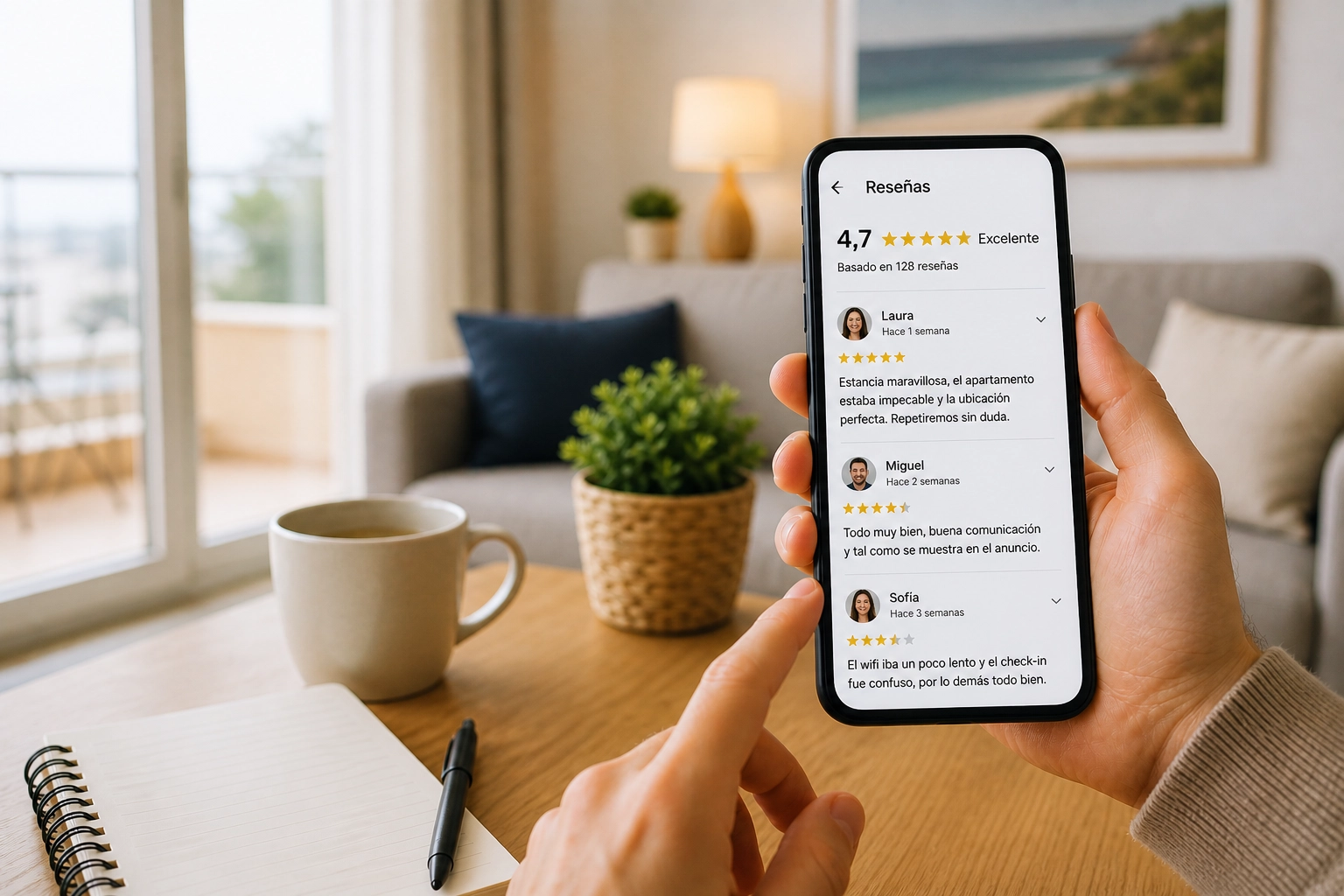
How reviews affect your occupancy
Many property owners know that reviews are important, but they don’t fully understand why they have such a strong impact on whether their listing appears more or less on Airbnb or Booking.com.
The simplest way to understand it is this:
Platforms show more often the listings that are more likely to be booked.
And to determine that, they mainly look at how guests behave. Reviews are one of the clearest signals of whether a property performs well… or not.
What Airbnb and Booking consider about your listing
Your average rating: your “trust level”
Your rating (for example, 4.8 vs 4.5) is one of the first things used to determine whether your property is reliable.
Higher ratings → more visibility
Lower ratings → less visibility
For example:
4.8 → highly competitive
4.7 → still good, but starting to show
4.5 → already losing ground to competitors
In a market like the Canary Islands, where there are thousands of listings, this difference can mean no longer appearing in top positions.
How many reviews you have: how much they trust you
Platforms trust listings with a large number of good reviews more than those with just a few perfect ones.
For example:
100 good reviews → strong trust
8 perfect reviews → less certainty
This shows that:
You’ve hosted many guests
Your quality is consistent
It’s not just “luck”
If you receive recent reviews: how active your listing is
If weeks or months go by without reviews:
Your listing appears less active
It loses strength compared to others
On the other hand, if you receive reviews consistently:
You gain visibility
You move up in rankings
“This property is being booked right now, let’s show it more.”
If you respond to reviews: how you manage problems
When property owners respond to reviews—whether positive or negative—they build trust, project professionalism, and show that they are attentive to guest feedback.
This has two key effects:
Guests trust you more
The platform understands that your property is well managed
The negative review loop
A single negative review is not usually a serious issue—in fact, it’s normal for any property. The problem begins when these reviews become frequent or, more importantly, when they start to influence how potential guests behave when viewing your listing. This is where consequences arise that many owners don’t immediately notice, but which directly impact bookings.
On one hand, your visibility begins to decline gradually. Each negative review can slightly lower your average rating and introduce doubt for guests comparing your property with others. When a potential guest sees repeated comments about similar issues—such as cleanliness, noise, or lack of communication—your listing starts to feel like a riskier option compared to others that appear more reliable. As a result, platforms tend to prioritize listings that generate more trust, meaning that, over time, other properties begin to move ahead of yours. This doesn’t happen overnight, but in highly competitive markets like the Canary Islands, even small differences can quickly translate into a loss of visibility.
However, the biggest impact is not just where your listing appears, but what happens once a guest clicks on it. You may still receive views, but if guests read negative reviews, hesitate, and then choose another property, the issue becomes more serious: you are losing bookings. This creates a compounding effect, as platforms interpret this behavior as a signal that your listing is not convincing enough. If many users click on your property but don’t complete a booking, it will gradually be shown less often, as other listings perform better.
This creates what we can call a chain reaction: negative reviews reduce trust, that lack of trust leads to fewer bookings, and fewer bookings result in lower visibility. From there, it becomes harder to attract new guests and, consequently, harder to generate new positive reviews to balance the situation. That’s why the real risk is not a single bad review, but allowing them to accumulate or failing to manage them properly, as they can ultimately affect your occupancy and revenue.
Review strategy to increase your visibility and bookings
Once you understand how negative reviews affect your listing, the next step is not to avoid them at all costs, but to manage and offset them strategically.
Because the reality is simple:
You don’t need to eliminate negative reviews.
You need to reduce their impact.
Ask for reviews actively
Many satisfied guests don’t leave reviews simply because they are not asked.
That’s why it’s important to:
Send a message after check-out
Thank them for their stay
Invite them to leave a review naturally
Example:
“Thank you for your stay! We’re glad you enjoyed it.
If you have a minute, your review really helps us 😊”
When done correctly, this can significantly increase the number of reviews without feeling intrusive.
Create experiences that generate reviews
Reviews are not requested—they are triggered.
Small details can make a big difference in how guests remember their stay:
Local welcome products 🍷
Snacks
A personalized guide to the area
This increases:
Guest satisfaction
The likelihood of receiving positive reviews
Your overall rating
Do an active check-in: prevent problems before they turn into negative reviews
This is one of the most underrated yet effective strategies.
Many issues that end up in negative reviews could have been resolved during the stay.
A simple follow-up message after arrival can prevent this:
“Hi, how is everything? Were you able to check in without any issues?
Let us know if you need anything 😊”
This allows you to:
Detect issues early (Wi-Fi, cleaning, access, etc.)
Resolve them before frustration builds
Show that you are attentive and available
Result:
Fewer negative reviews
Better guest experience
Higher chances of positive feedback
Fake or unfair reviews
Although uncommon, you may sometimes receive a false, exaggerated, or unfair review that does not reflect what actually happened during the stay. This can be frustrating, but it’s important to understand that not all negative reviews can be removed. Platforms like Airbnb and Booking only take action when a review violates their policies.
For example, you may have grounds to report a review if:
The guest did not actually stay at the property
The content includes offensive language or threats
There is clearly false information
There is evidence of blackmail
In these cases, the process involves reporting the review directly through the platform, clearly explaining why it violates the rules and, most importantly, providing evidence. This is where many property owners fail—not because they are wrong, but because they don’t support their claim properly. Conversations with the guest, photos of the property, check-in records, or any relevant documentation can significantly increase the chances of having the review removed.
However, there is one key point to keep in mind: even if you report the review, you should never leave it unanswered. Your response is not meant for the guest, but for future potential customers who will read that review. A professional, calm, and fact-based response builds trust and can neutralize much of the negative impact, even if the review is not removed.
Need Help Managing Reviews and Guests?
Dealing with reviews, guests, maintenance, cleaning, bookings, and taxes? It’s a full-time job. That’s why many Tenerife vacation home owners trust Pambnb to manage it all.
✅ We handle:
Guest communication & review management
24/7 support and emergency responses
Professional cleaning and maintenance
Listing optimization for top rankings
Local guidance to turn reviews into revenue
💬 Let’s talk! Contact us now at info@pambnb.com or through our contact page https://pambnb.com/en/contact for a free consultation.
Every Review is an Opportunity
In the world of short-term rentals, negative reviews are inevitable. But what matters most is how you respond.
By addressing criticism with grace, using feedback to improve, and consistently delivering excellent guest experiences, you’ll turn one-star moments into five-star success. And when you work with experts like Pambnb, you don’t have to face those challenges alone.